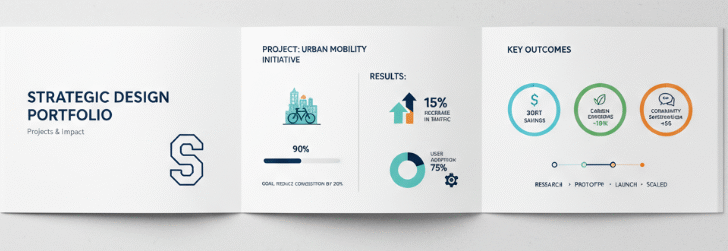
For years, designers believed the formula was simple:
Make pretty mockups → Upload to Behance → Clients will magically find you.
That era is gone.
Behance is flooded.
Dribbble is pay-to-play.
Instagram is algorithm roulette.
And clients?
They no longer browse portfolios — they want proof, clarity, and results.
Welcome to the Post-Behance Era of Design Portfolios — where what you show matters way less than how you show it.
This is how to build a portfolio that actually works in 2025.
🚫 The Old Portfolio Rules (That Don’t Work Anymore)
❌ Only mockups and visuals
❌ Posting without context
❌ Hoping clients “discover” you on platforms
❌ Focusing on aesthetic instead of results
❌ Putting every single project instead of being selective
These portfolios do not convert. Because clients aren’t just looking for creatives anymore—
they’re looking for strategic problem solvers.
✅ The New Rules of Portfolio Building in 2025
1. Portfolio = Landing Page, Not Gallery
Your portfolio shouldn’t act like a museum.
It should act like a sales funnel.
That means:
✔ Clear positioning
✔ Defined audience
✔ Conversion-focused structure
✔ A persuasive narrative
Your portfolio should answer:
“Why should I hire YOU over anyone else?”
2. Show the Process, Not Just the Result
Clients want transparency.
Don’t just show the final design — show:
🧠 Concept
📝 Strategy
🎯 Goals
📊 Outcome
Case studies outperform mockups every single time.
Screenshots without context = wallpaper.
3. Make It About Results — Not Aesthetics
Replace:
❌ “Logo Design for Coffee Brand”
with:
✔ “Redesigned brand identity → increased retail sales by 48% in 90 days”
Even if you don’t have data, show:
⭐ Engagement improvements
⭐ User experience improvements
⭐ Brand clarity
⭐ Before & after examples
Design must have a measurable purpose.
4. You Need a Personal Website (Not Just a Profile)
Behance, Dribbble, Instagram = rented land.
Your website = an asset you control.
Use your website to:
✔ Capture leads
✔ Build authority
✔ Rank on Google
✔ Build a personal brand
Even a simple one-page site beats a profile you don’t own.
5. Speak Like a Strategist, Not a Designer
Your clients don’t speak design.
They speak business & outcomes.
Replace:
❌ “I used a minimal sans serif to create elegance”
with:
✔ “We intentionally used a clean, modern type system to increase brand trust and readability.”
The words you use are as important as the visuals.
6. Niche > Generalist
A portfolio for “everyone” attracts no one.
Example niches:
– Luxury skincare brands
– SaaS dashboard UI
– Real estate branding
– Female-led business branding
– AI startups
– Fitness creators
The narrower the niche, the easier it is to attract high-quality clients.
7. Your Portfolio Should Sell Your Process
Clients want to know:
“How will it feel working with you?”
Include:
✔ Your process
✔ Your framework
✔ Your steps
✔ Your deliverables
✔ Your timeline
This builds trust & eliminates objections.
8. Video Is Now a Competitive Advantage
Static images are forgettable.
Video is the new portfolio king.
Use video for:
🎥 Case study breakdowns
🎥 Screen recordings
🎥 Before/after comparisons
🎥 Motion reveals
🎥 Personal introduction
A designer who shows up on camera immediately feels more real and trustworthy.
9. Social Proof Matters More Than Ever
Add:
⭐ Testimonials
⭐ Client screenshots
⭐ Brand logos
⭐ Case study stats
⭐ Before-and-after metrics
Proof beats “good design” every time.
10. Your Portfolio = A Marketing Tool, Not a Storage Folder
It should:
✔ Attract the right clients
✔ Filter out the wrong ones
✔ Position you as the expert
✔ Turn interest into conversations
✔ Drive leads and sales
A portfolio that doesn’t convert is just a gallery.
🧠 Final Takeaway
In a world where everyone has access to templates, AI, and Behance:
Your portfolio is not just what you show — it’s how you communicate value.
The new portfolio is:
✨ Positioning + storytelling + proof
Not just pretty pictures.
Build a portfolio that sells your thinking, not just your talent.
That is how you win in 2025.