Introduction
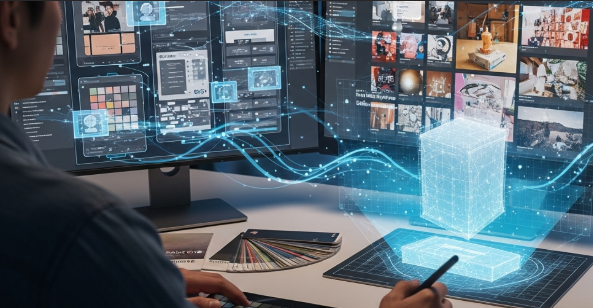
The rapid evolution of artificial intelligence has fundamentally reshaped the creative industry—especially graphic design. What was once a field driven solely by human imagination is now enhanced by intelligent algorithms, automation tools, and machine-assisted workflows. Instead of replacing designers, AI is emerging as a powerful partner that amplifies creativity, accelerates production, and unlocks new forms of visual expression. This shift has given birth to a new era: AI-augmented creativity.
In this future, designers who learn to merge human insight with machine efficiency are positioned to become the most valuable players in a competitive digital landscape. This article explores how modern designers can stay ahead by embracing AI as an ally, not a threat.
Why AI-Augmented Creativity Matters
1. The Design Industry Is Becoming Faster and More Demanding
Businesses now require rapid content production—social media graphics, branding updates, ad creatives, UI mockups, and more. AI tools allow designers to respond quicker without sacrificing originality.
2. AI Enhances, Not Replaces, Human Creativity
AI generates possibilities, but designers determine direction, emotion, and meaning. AI can produce variations, but only humans can judge what aligns with a brand’s soul.
3. Competitiveness Depends on Adaptation
Clients increasingly prefer designers who can combine artistic intuition with efficient, AI-powered workflows.
Key Areas Where Designers Benefit From AI
1. Concept Development & Brainstorming
AI assists with:
Moodboard generation
Color palette discovery
Style exploration with prompts
Thumbnail layouts
This speeds up experimentation without limiting creativity.
2. Automation of Repetitive Tasks
Designers can automate:
Resizing assets
Background removal
File formatting
Basic image cleanup
Template creation
This frees time for high-value creative work.
3. Advanced Image Creation
AI image models allow designers to produce:
Concept art
Illustrations
Realistic renders
Mockups
These become starting points for refinement, not final results.
4. Smarter Design Decisions
AI helps analyze:
Composition balance
Color harmony
Visual hierarchy
Readability metrics
This improves design accuracy and user engagement.
Maintaining Human Originality in an AI-Powered World
1. Keep Your Signature Style
While AI can mimic trends, it cannot replicate your identity, experience, or personal taste. Designers who develop a recognizable style will remain irreplaceable.
2. Use AI as a Collaborator, Not a Crutch
Instead of asking AI to “create the whole design,” use it for:
Exploration
Variations
Early sketches
Ideation
Then refine manually with your craft.
3. Continue Learning Human-Centric Skills
The most future-proof skills include:
Storytelling
Conceptual thinking
Communication
Emotion-driven design
Branding psychology
AI does not use intuition—humans do.
How Designers Stay Competitive
To succeed in the future of design, creatives should:
Master AI tools relevant to their niche (branding, illustration, UI, motion).
Build a portfolio that showcases AI-assisted creativity.
Highlight manual craftsmanship as a differentiator.
Offer “AI + Designer Hybrid Services,” which are becoming highly in demand.
Conclusion
AI is not the end of creativity—it is the beginning of a new design frontier. Designers who embrace AI as a creative partner will produce work that is faster, smarter, and more innovative. The future belongs to those who blend human imagination with intelligent automation to stay competitive, relevant, and deeply original.