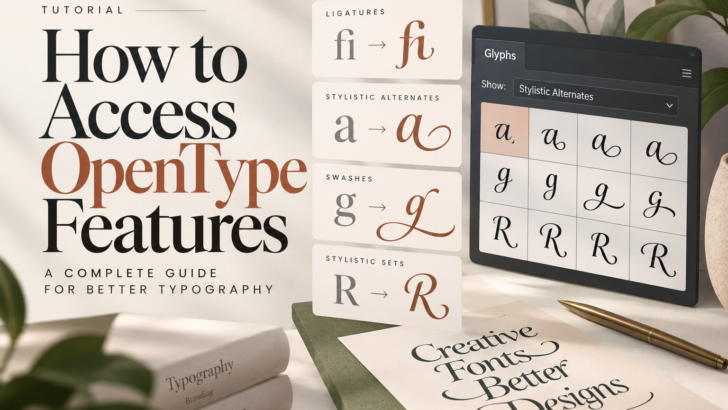
Tutorial: How to Access OpenType Features in Fonts


OpenType features allow you to access special characters, ligatures, stylistic alternates, swashes, and other typographic details included in a font. These features can help you create more expressive typography for logos, branding, packaging, and editorial design.
However, OpenType features are not accessed in the same way in every design application. This tutorial explains how to use them in popular design software.
1. What Are OpenType Features?
OpenType features are built-in typographic functions that let you change how certain characters appear or how letter combinations are displayed.
Some common OpenType features include:

Ligatures (liga)
Combine two or more letters into a specially designed character. For example, f and i may become a connected fi ligature.

Stylistic Alternates (salt)
Replace standard letters with alternative designs for a more distinctive look.

Swashes (swsh)
Add decorative flourishes to selected letters, especially useful for script fonts and elegant lettering.

Stylistic Sets (ss01, ss02, etc.)
Switch groups of characters to coordinated alternative designs.
Note: The available features depend on the font. Not every font includes all these options.
2. How to Access OpenType Features in Adobe Illustrator

Adobe Illustrator is one of the most convenient applications for accessing OpenType features.
Install the font on your computer.
Open Adobe Illustrator and create a new document.
Select the Type Tool (T) and type your text.
Select the text you want to customize.
Open Window → Type → Character.
Open the Character panel menu or locate the available OpenType controls.
Enable features such as Ligatures, Stylistic Alternates, or Swash, if available.
Some versions of Illustrator display additional OpenType controls in the Properties panel or the contextual text toolbar.
Tip: To access a specific alternate character, select the individual letter. If a Glyphs panel is available, open Window → Type → Glyphs and double-click the alternate glyph you want to insert.
3. How to Access OpenType Features in Adobe Photoshop

You can also use OpenType features in Adobe Photoshop for posters, social media graphics, and branding mockups.
Open Photoshop and create a document.
Select the Type Tool and type your text.
Highlight the characters you want to modify.
Go to Window → Character.
Look for the OpenType controls in the Character panel.
Enable the desired feature, such as ligatures or stylistic alternates.
If you want to insert a particular alternative glyph, open Window → Glyphs when that panel is available in your version of Photoshop.
Important: The options available may vary depending on your Photoshop version and the font’s supported features.
4. How to Access OpenType Features in Adobe InDesign

Adobe InDesign offers extensive typographic controls, making it particularly useful for editorial layouts, magazines, and professional typography.
Open your InDesign document.
Create a text frame and type your text.
Select the text you want to modify.
Open Window → Type & Tables → Character.
Open the Character panel menu to find the available OpenType options.
Enable the features you need.
For stylistic sets, look for the OpenType submenu or the relevant option in the Character panel menu. You can also use the Glyphs panel to browse and insert individual characters.
5. How to Access Alternate Glyphs Using the Glyphs Panel
Sometimes, you may want to choose a specific alternate instead of enabling an automatic feature.
Follow these steps:
Type your text and select the letter you want to replace.
Open the Glyphs panel from the application’s Window menu.
Choose the active font if necessary.
Browse the available glyphs and alternate characters.
Double-click the character you want to insert.
This method is particularly useful for decorative script fonts, display fonts, and fonts with extensive alternate character collections.
6. What If OpenType Features Do Not Work?
If the features are missing or do not appear to work, check the following:
Font format: Use the font file supplied for your application, commonly OTF or TTF.
Feature support: Confirm that the font actually contains the feature you want to use.
Correct selection: Select the relevant text or character before applying the feature.
Application support: Not all applications support every OpenType feature.
Glyphs panel: Try inserting the alternate manually if automatic substitution is unavailable.
Font installation: Restart the application after installing a new font if it does not appear correctly.
Some applications, including certain mobile design apps, may have limited support for advanced OpenType features. In those cases, using a separate font file containing the desired alternate characters may be a practical workaround if the font designer provides one.
7. Which Applications Support OpenType Features?
| Application | General support |
|---|---|
| Adobe Illustrator | Extensive |
| Adobe Photoshop | Good, with version-dependent limitations |
| Adobe InDesign | Extensive |
| Microsoft Word | Supports selected features through advanced typography settings |
| Affinity Designer | Supports many OpenType features |
| Procreate | Limited; varies by feature and version |
| Canva | Feature availability varies; advanced controls may be limited |
Final Thoughts
OpenType features can make a significant difference in the quality of your typography. Whether you are designing a logo, creating packaging, or developing a brand identity, experimenting with ligatures, stylistic alternates, and swashes can help you achieve a more distinctive result.
When choosing a font, check its feature list and preview images to understand which typographic options are included.
Explore the font collections at Zeenesia Studio to discover typefaces for branding, logos, packaging, and creative projects.