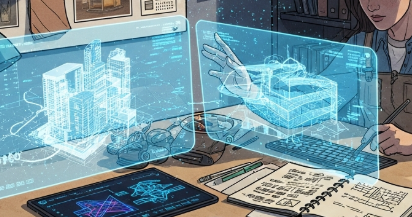
The Future of Graphic Design: Blending Human Imagination With Intelligent Automation

As the design world accelerates into an era shaped by artificial intelligence, automation, and rapid technological change, one question rises above the rest: What will the future of graphic design look like?

The answer is neither purely human nor entirely machine-driven. Instead, the next chapter of design is being written at the intersection of human imagination and intelligent automation—a powerful partnership that enhances creativity rather than replacing it.

This article explores how designers can thrive in a hybrid future, why human originality remains irreplaceable, and how AI-driven tools will redefine the landscape of creative work.


1. A Future Built on Collaboration, Not Replacement

Contrary to fears of AI taking over design jobs, the true trajectory of the industry is collaboration.
Intelligent automation is not here to eliminate designers—it is here to extend their capabilities.

AI excels at:

  • generating visual concepts rapidly

  • analyzing design patterns

  • automating repetitive tasks

  • enhancing productivity at scale

Humans excel at:

  • storytelling

  • emotional expression

  • cultural understanding

  • creative intuition

  • conceptual thinking

The future belongs to designers who master both worlds.


2. AI as a Creative Accelerator

Intelligent automation allows designers to experiment faster than ever before.
Instead of spending hours mocking up variations, AI can generate dozens in seconds.

What this means for designers:

  • more time for strategy

  • deeper creative exploration

  • quicker iteration and refinement

  • the ability to test ideas without heavy manual work

AI becomes the new “creative superpower”—not a shortcut, but a launchpad for imagination.


3. The Human Mind Remains the Source of Originality

While AI can mimic styles and generate patterns, it cannot originate authentic creative insight.

AI learns from:

  • existing data

  • design trends

  • historical visuals

Humans create from:

  • lived experiences

  • personal emotion

  • intuition

  • identity and worldview

  • cultural nuance

Originality does not come from algorithms.
It comes from human imagination—and that is what will continue to give designers a competitive edge in the future.


4. Intelligent Automation Will Transform Workflows

Graphic design workflows will evolve dramatically in the coming years:

🔹 From Manual Execution → To Assisted Creation

Designers will shift from doing everything by hand to curating and directing outputs.

🔹 From Tedious Repetition → To Smart Automation

Resizing assets, formatting layouts, removing backgrounds—AI handles these effortlessly.

🔹 From Linear Workflow → To Multi-Concept Exploration

Designers can explore 20 concepts instead of 2, making the creative process more dynamic.

🔹 From Just Design → To Strategy + Creative Direction

Future designers will play a bigger role in brand strategy as tools handle execution.


5. Hyper-Personalized Design Through AI Insights

AI will enable new possibilities in personalization—something manual workflows could never achieve at scale.

Designers will be able to produce:

  • customized visuals for specific audience segments

  • adaptive layouts based on user behavior

  • data-driven design decisions backed by analytics

  • real-time creative optimization

This creates a future where design is not just beautiful—but smart, responsive, and deeply relevant.


6. Ethical Design and Human Oversight Become Essential

With automation comes responsibility.
Designers will play a critical role as guardians of ethics, ensuring AI is used responsibly.

Designers must oversee:

  • avoiding bias in AI-generated visuals

  • respecting copyright and originality

  • maintaining diversity in representation

  • ensuring cultural sensitivity

  • protecting authenticity in brand identity

Human oversight ensures that automation enhances creativity without compromising integrity.


7. The Designer of the Future: A Hybrid Creative Professional

The most successful designers will not be those who resist AI, but those who embrace it with a creative mindset.

The future designer will be:

  • part artist

  • part creative director

  • part technologist

  • part strategist

  • part problem solver

This hybrid skillset allows designers to use automation intelligently while grounding every project in human imagination.


8. Why Human Imagination Will Always Matter

As automation grows more powerful, human imagination becomes even more valuable.
Technology can generate visuals—but only humans create meaning.

Design is not just about aesthetics.
It is about:

  • emotion

  • storytelling

  • connection

  • purpose

  • identity

AI enhances the craft, but the human mind defines the vision.


Conclusion: The Future Is Not Human vs. Machine—It’s Human Plus Machine

Graphic design stands on the edge of a transformative era. Intelligent automation is not the end of creativity—but the beginning of a new creative renaissance.

Designers who blend imagination with technology will unlock previously impossible levels of innovation.
AI is the engine.
Humans are the drivers.

The future of design belongs to those who embrace the tools of tomorrow while staying deeply connected to the artistic soul within them.

Top 10 AI Tools for Graphic Designers in 2025

Introduction
AI has completely changed the world of graphic design. What used to take hours can now be done in minutes — from generating ideas to creating full layouts.

But with hundreds of new tools launching every year, it can be hard to know which ones are actually worth your time.

To help you stay ahead, here are the 10 best AI tools for graphic designers in 2025 — tools that boost creativity, speed up workflows, and help you produce professional-quality designs with less effort.


1. Adobe Firefly

Adobe Firefly is Adobe’s answer to AI creativity. It integrates directly into Photoshop and Illustrator, allowing designers to generate textures, backgrounds, or complete scenes using text prompts.

💡 Why it’s great: Seamless integration with Creative Cloud and professional-level control.


2. Canva Magic Studio

Perfect for beginners and pros alike, Canva Magic Studio uses AI to generate layouts, remove backgrounds, and even write captions.

💡 Why it’s great: Fast, intuitive, and ideal for social media or marketing design.


3. Midjourney

Midjourney remains one of the most powerful AI image generators available. It’s used by designers to create concept art, branding mockups, and mood boards.

💡 Why it’s great: Stunning visual quality and artistic control — perfect for inspiration.


4. Runway ML

Runway ML is a creative video and motion design platform powered by AI. It lets you edit videos, remove objects, and generate effects — all with natural language prompts.

💡 Why it’s great: Excellent for motion designers and content creators.


5. DALL·E 3 (by OpenAI)

DALL·E 3 can turn detailed text descriptions into stunning visuals. Its integration with ChatGPT (like me 😉) makes it easy to brainstorm and generate design ideas instantly.

💡 Why it’s great: Perfect for generating unique visual concepts quickly.


6. Khroma

Color lovers, this one’s for you! Khroma uses AI to learn your color preferences and generate palettes that match your unique design style.

💡 Why it’s great: Helps you create brand-specific and emotionally driven color schemes.


7. Looka

Looka is an AI-powered logo maker that simplifies brand identity design. It helps you create professional logos, business cards, and branding kits in minutes.

💡 Why it’s great: Great for startups or freelancers looking for quick, polished results.


8. Designs.ai

Designs.ai offers an entire creative suite — logo maker, video editor, and voiceover tools — all powered by AI.

💡 Why it’s great: An all-in-one solution for marketers and designers on a tight deadline.


9. Fotor AI Image Generator

Fotor lets designers create realistic or artistic images instantly. Its AI retouching and portrait enhancement features are especially useful for photography-based projects.

💡 Why it’s great: Combines editing tools with smart AI generation.


10. Uizard

Uizard transforms simple sketches or screenshots into fully functional app and web prototypes. Perfect for UI/UX designers who want to move fast from idea to interface.

💡 Why it’s great: Turns your hand-drawn ideas into interactive mockups — instantly.


Conclusion
AI isn’t replacing designers — it’s empowering them.
These tools don’t just make your workflow faster; they make it smarter.

Whether you’re designing a logo, creating a color palette, or prototyping an app, AI helps you spend less time on routine work and more time doing what matters most: being creative.