Design Thinking Process Explained: A Practical Step-by-Step Guide

A Practical Guide to the Design Thinking Process

Introduction

The design thinking process is a structured yet flexible approach used to solve complex problems with a strong focus on user needs. I have applied this method directly in product design, service improvement, and digital projects with startups and established organizations. Each time, the same principle holds true: better understanding leads to better solutions.

In this article, you will learn how the design thinking process works in real situations, not just in theory. You will also find clear steps, practical examples, and actionable advice you can apply immediately.


What Is the Design Thinking Process?

The design thinking process is a human-centered framework for innovation. It helps teams understand users, challenge assumptions, and test solutions early. Instead of jumping to answers, it prioritizes learning and iteration.

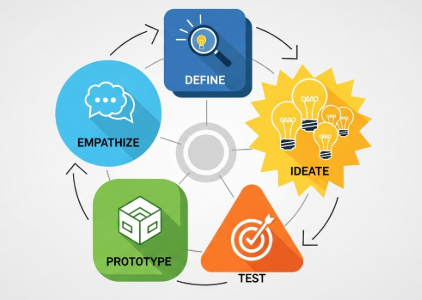
Most frameworks describe five core stages:

  1. Empathize

  2. Define

  3. Ideate

  4. Prototype

  5. Test

Although these stages appear linear, the process is iterative. Teams often move back and forth as they gain new insights.

According to the Interaction Design Foundation, design thinking improves problem framing and reduces solution risk through early validation. You can review their research-based explanation here:
https://www.interaction-design.org/literature/topics/design-thinking


Why the Design Thinking Process Matters in Practice

In real projects, assumptions are expensive. When teams skip user understanding, they risk building the wrong solution. I have seen this happen in mobile apps and internal tools that failed after launch.

The design thinking process reduces that risk by:

  • Focusing on real user problems

  • Encouraging cross-functional collaboration

  • Testing ideas before large investments

As a result, decisions rely more on evidence and less on opinion.


Stage 1: Empathize – Understand the User Deeply

Empathy is the foundation of the design thinking process. At this stage, the goal is to understand users in their real context.

Practical Empathy Methods

From direct experience, these techniques work best:

  • One-on-one user interviews

  • Contextual observation

  • Shadowing users during tasks

  • Reviewing support tickets or complaints

For example, in a SaaS onboarding project, interviews revealed that users felt overwhelmed, not confused. This insight changed the entire solution direction.

Key Output of This Stage

  • User quotes

  • Pain points

  • Behavioral patterns

Without empathy, the next stages lose relevance.


Stage 2: Define – Frame the Right Problem

After gathering insights, the next step is clarity. The define stage synthesizes findings into a clear problem statement.

How to Write a Strong Problem Statement

A useful format is:

“Users need a way to ___ because ___.”

For example:
“New users need a simpler setup flow because they abandon the product within ten minutes.”

This framing keeps the team aligned. It also prevents solution bias early in the design thinking process.


Stage 3: Ideate – Explore Many Solutions

Ideation focuses on quantity before quality. At this point, judgment is temporarily suspended.

Effective Ideation Techniques

  • Brainwriting

  • Crazy 8s

  • “How Might We” questions

  • Mind mapping

In a fintech project I worked on, generating over 40 ideas in one session led to a solution no one initially proposed. That solution later tested best with users.

Important Rule

Separate idea generation from evaluation. Mixing them limits creativity and reduces outcomes.


Stage 4: Prototype – Make Ideas Tangible

Prototyping turns abstract ideas into something users can interact with. In the design thinking process, prototypes are learning tools, not final products.

Types of Prototypes

  • Paper sketches

  • Clickable wireframes

  • Role-playing scenarios

  • Low-code mockups

For example, a paper prototype once revealed navigation issues within minutes. Fixing them later would have cost weeks.

Best Practice

Prototype only what you need to test. Speed matters more than polish.


Stage 5: Test – Learn and Iterate

Testing validates assumptions. It also uncovers new insights that often send teams back to earlier stages.

What to Test

  • Usability

  • Clarity of value

  • Emotional response

  • Task completion

During testing for an e-commerce checkout redesign, users completed tasks faster but reported lower confidence. That feedback led to better visual cues.

Testing is never the end. It feeds continuous improvement in the design thinking process.


Real-World Mini Case Study

Problem

A local education platform faced declining student engagement.

Approach

The team applied the design thinking process:

  • Interviewed students and teachers

  • Defined the problem as motivation-related, not content-related

  • Ideated gamification concepts

  • Prototyped a progress tracker

  • Tested it with a small group

Result

Engagement increased by 28% in one month. The solution worked because it addressed real user motivation.


Common Mistakes to Avoid

Even experienced teams make errors.

  • Skipping empathy due to time pressure

  • Defining problems too broadly

  • Falling in love with one idea

  • Testing only once

Avoiding these mistakes keeps the design thinking process effective and grounded.


How to Apply the Design Thinking Process Step by Step

Here is a simple, actionable workflow:

  1. Schedule user interviews

  2. Document insights visually

  3. Write a clear problem statement

  4. Run a structured ideation session

  5. Build a low-fidelity prototype

  6. Test with real users

  7. Iterate based on feedback

This approach works for products, services, and even internal processes.


Key Takeaways

Design Thinking Essentials

  • Start with empathy, not solutions

  • Define problems clearly

  • Prototype early and cheaply

  • Test with real users

  • Iterate continuously

The design thinking process is not a trend. It is a practical mindset supported by evidence and experience.


Frequently Asked Questions

Is the design thinking process only for designers?

No. Product managers, marketers, and engineers use it effectively.

How long does the process take?

It depends on scope. Some cycles take days, others weeks.

Can small teams use it?

Yes. Small teams often move faster through the stages.

Is it suitable for non-digital problems?

Absolutely. It works well for services and operations.

Conclusion

The design thinking process helps teams solve the right problems before building solutions. Through empathy, experimentation, and iteration, it reduces risk and increases impact. Based on real-world application, its value lies not in theory but in disciplined practice.

When applied consistently, the design thinking process becomes a reliable engine for meaningful innovation.